
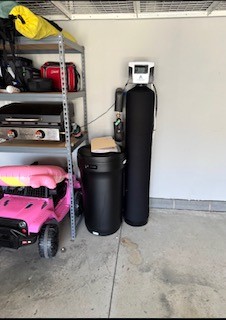
Do You Need a Water Softener, a Whole-House Filter, or Both?
If you’re considering improving the water in your home, you’ve probably come across two common options: a water softener and a whole-house water filter.
They are often talked about as though they do the same thing.
They don’t.
A water softener primarily treats hardness minerals such as calcium and magnesium. A whole-house water filtration system is designed to address other water-quality concerns such as chlorine, chloramine, taste, odor, and certain contaminants.
For many Charlotte and Lake Norman homeowners, however, the best answer doesn’t have to be one or the other.
A combination filtration and softening system can provide the benefits of both in a single system.
Here’s how to decide what makes sense for your home.
What Does a Water Softener Do?
A traditional water softener is designed primarily to remove hardness minerals—mainly calcium and magnesium—from the water through a process called ion exchange.
Hard water isn’t necessarily unsafe to drink, but it can create problems throughout a home.
Hardness can contribute to:
- White scale on faucets and fixtures
- Spots on glassware and shower doors
- Scale buildup inside water heaters and appliances
- Soap and shampoo that don’t lather as well
- Increased soap and detergent use
- Dry-feeling skin and hair
- Mineral buildup on plumbing fixtures
Softening the water reduces these hardness minerals before the water travels throughout the house.
For homeowners who have experienced truly hard water, the difference can be immediately noticeable.
What Doesn’t a Water Softener Do?
This is where there is often confusion.
A water softener is not the same thing as a water filter.
A traditional softener isn’t designed primarily to remove chlorine, chloramine, taste and odor, or the broad range of contaminants that homeowners may be concerned about in their drinking water.
Its primary job is hardness removal.
That’s why buying a water softener when your main complaint is chlorine taste or odor may not solve the problem you’re actually trying to fix.
The water should determine the treatment—not the other way around.
What Does a Whole-House Water Filter Do?
A whole-house filtration system treats water as it enters the home, before it reaches your faucets, showers, appliances, and plumbing.
The exact contaminants it reduces depend on the filtration media being used.
For municipal water, carbon filtration is commonly used to reduce chlorine, taste, odor, and certain organic contaminants.
At Artisanal Water Solutions, we frequently use catalytic carbon in our whole-house filtration systems.
Catalytic carbon provides excellent filtration while also offering greater treatment capability for certain applications than standard activated carbon.
The result is filtered water throughout the home—not just at the kitchen sink.
That means the water you drink, cook with, shower in, wash clothes in, and run through your appliances has been treated.
Does a Whole-House Water Filter Soften Water?
Not necessarily.
This is essentially the reverse of the previous question.
A carbon filtration system can do an excellent job treating chlorine and improving taste and odor, but carbon does not remove hardness minerals from the water.
If your water contains calcium and magnesium, those minerals remain after carbon filtration.
So:
Water softener = hardness treatment
Whole-house carbon filter = filtration
They solve different problems.
What About Charlotte and Lake Norman Municipal Water?
This is where the decision becomes more interesting.
Much of the municipal water we test throughout the Charlotte and Lake Norman area is relatively soft compared with areas of the country known for extremely hard water.
That means many homeowners don’t necessarily have a severe hardness problem requiring a water softener.
However, relatively soft doesn’t mean there are no benefits to softening it further.
Even moderate levels of hardness can contribute to spotting, mineral buildup, soap usage, and scale inside water-using appliances.
At the same time, many municipal-water customers who contact us are primarily interested in improving things such as:
- Chlorine taste and smell
- Overall taste of their drinking water
- Shower water
- Dry-feeling skin and hair
- Scale and spotting
- Water quality throughout the home
- Concerns about contaminants in their water
That’s why we often look at filtration and softening together rather than treating them as competing options.
The Third Option: A Combination Filtration and Softening System
Homeowners don’t necessarily have to choose between a whole-house filter and a water softener.
Artisanal Water Solutions offers systems that combine catalytic carbon filtration and water softening into one treatment system.
This provides what we consider the best of both worlds.
The catalytic carbon portion of the system treats chlorine and other appropriate water-quality concerns, while the softening resin addresses calcium and magnesium hardness.
Instead of asking:
“Do I want filtered water or soft water?”
the homeowner can have:
Filtered AND softened water throughout the home.
Why a Combination System Can Make Sense in Charlotte
There is another important consideration: cost.
Because much of our local municipal water is already relatively soft, it generally doesn’t require an enormous amount of softening capacity.
When we’re already installing a whole-house filtration system, the additional cost of incorporating softening can therefore be relatively small compared with purchasing and installing two completely separate systems.
For many homeowners, that makes the decision less about whether they absolutely need a water softener and more about whether the additional benefits are worth the relatively modest additional cost.
You may not have extremely hard water.
But if you’re already investing in improving the water throughout your home, you may decide that reducing the remaining hardness makes sense too.
Should Everyone Choose a Combination System?
No.
We don’t believe every home needs the same water treatment system.
Some homeowners may only want whole-house filtration.
Others may have a specific hardness problem where softening is the primary concern.
And some homeowners want the benefits of both filtration and softening.
The right choice depends on:
- Your water source
- Your actual water hardness
- The disinfectant used in your municipal water
- Your specific water-quality concerns
- Your household water usage
- Your budget
- What you ultimately want your water to feel and taste like
That’s why we prefer to test the water and talk with the homeowner before recommending equipment.
What About Well Water?
Well water is different.
With a private well, we don’t recommend assuming that a carbon filter, softener, or combination unit is automatically the right answer.
Well water can contain hardness, iron, manganese, sulfur, low pH, sediment, nitrates, bacteria, and other conditions that may require completely different treatment.
Two homes located relatively close to one another can have very different well-water chemistry.
On-site testing is critical when designing a well-water treatment system.
A softener may be part of that treatment—but it shouldn’t automatically be the starting point.
Water Softener vs. Whole-House Filter: Which Should You Choose?
Here’s the simplest way to think about it.
If your primary problem is hardness:
A water softener may be appropriate.
If your primary concerns are chlorine, taste, odor, and overall municipal water quality:
Whole-house filtration may make more sense.
If you want the benefits of filtration AND softening:
A combination catalytic carbon and water softening system may provide the best overall solution.
For many Charlotte and Lake Norman municipal-water customers, that third option is worth considering because the additional cost of softening can be relatively small when incorporated into the filtration system.
Start With the Water, Not the Equipment
One of the biggest mistakes homeowners can make is deciding what equipment they want before determining what is actually in their water.
We take the opposite approach.
At Artisanal Water Solutions, we evaluate the water first, listen to what the homeowner wants to improve, and then recommend the appropriate treatment.
Sometimes that’s filtration.
Sometimes it’s softening.
Sometimes it’s both.
And sometimes the water doesn’t need nearly as much treatment as the homeowner expected.
Our goal isn’t to sell the most equipment.
It’s to recommend the right equipment for your water and your home.
Artisanal Water Solutions provides in-home water consultations throughout Charlotte, Lake Norman, and surrounding communities.
Love Your Water.
Quality treatment starts with knowing what’s actually in your water. Contact Artisanal Water today and get a free water test expert guidance for your Charlotte area water. Call or text (704) 315-6344 or fill out our contact form
