If you’ve been researching reverse osmosis (RO) drinking water systems, you’ve probably heard the claim that they “waste a lot of water.”
While there is some truth to that statement, it often lacks important context. The reality is that modern reverse osmosis systems are far more efficient than older models, and the amount of water used is often much smaller than people imagine.
Let’s take a closer look at how reverse osmosis works, how much water it actually uses, and whether it’s truly a concern for most homeowners.
Why Reverse Osmosis Uses Water
Reverse osmosis is one of the most effective water treatment technologies available for removing contaminants from drinking water.
An RO membrane works by forcing water through microscopic pores that block dissolved contaminants such as:
- Lead
- Arsenic
- PFAS (“forever chemicals”)
- Nitrates
- Chromium
- Fluoride
- Sodium
- Many other dissolved impurities
As clean water passes through the membrane, contaminants are flushed away in a separate stream of water known as concentrate or reject water.
This flushing action is necessary. Without it, contaminants would quickly build up on the membrane and reduce its performance.
Older RO Systems Were Less Efficient
Years ago, many residential reverse osmosis systems operated at ratios of 4:1 or even 5:1.
That means for every gallon of purified water produced, four to five gallons could be sent to the drain.
While effective at producing high-quality drinking water, these older systems were not particularly water efficient.
Unfortunately, many of the statistics still circulating online today are based on these older technologies.
Modern Reverse Osmosis Systems Are Much More Efficient
Today’s premium reverse osmosis systems have improved dramatically.
Advances in membrane technology, flow restrictors, permeate pumps, and system design have allowed many modern RO systems to achieve significantly better efficiency.
Many quality systems now operate closer to:
- 2:1 ratios
- 1.5:1 ratios
- Some specialty systems can approach 1:1 under ideal conditions
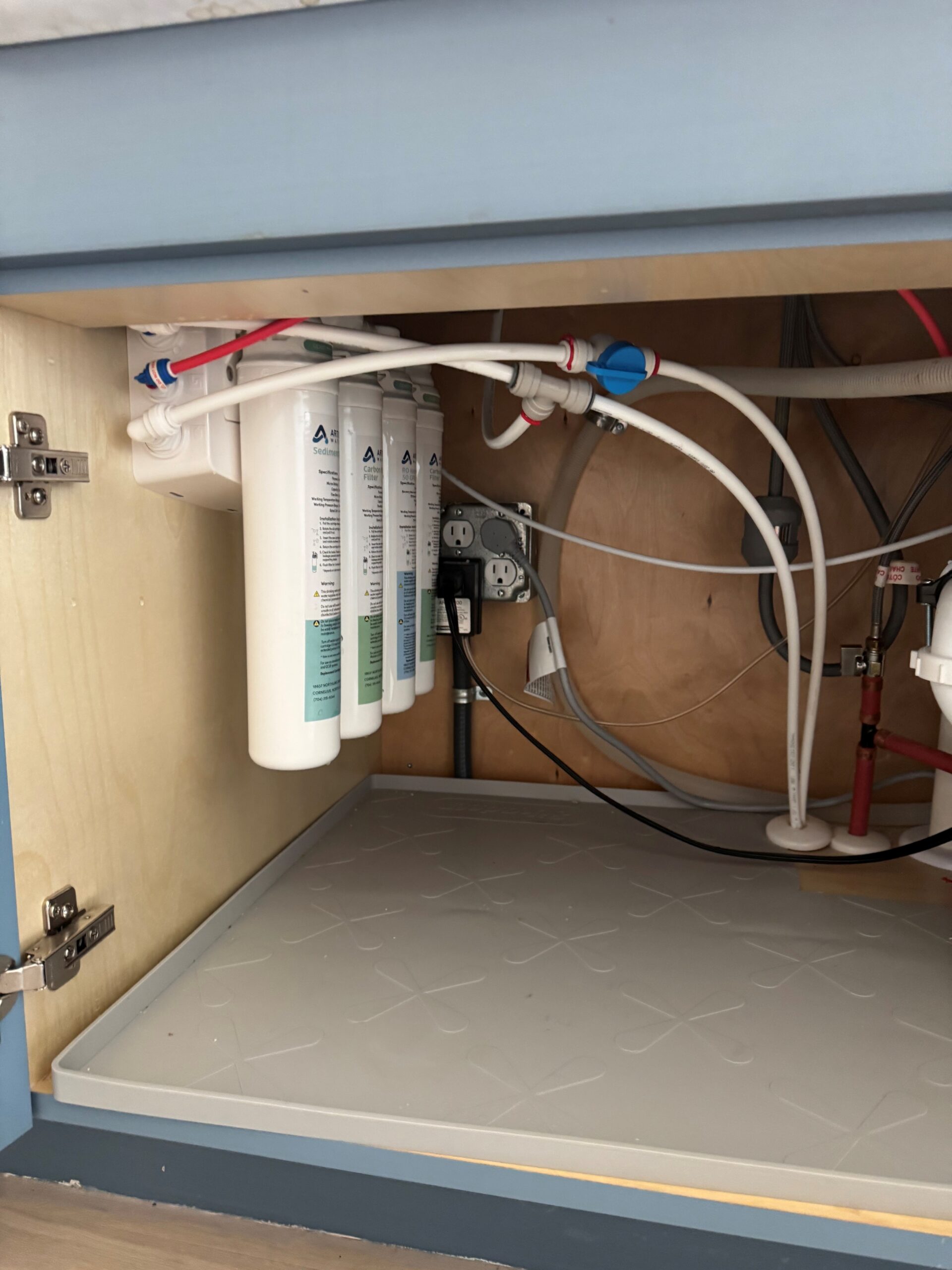
Modern reverse osmosis technology has improved dramatically. For example, our Elite Reverse Osmosis System is designed to maximize water production while minimizing waste, allowing homeowners to enjoy high-quality drinking water without the inefficiencies often associated with older RO systems. This means homeowners can produce the same amount of purified drinking water while using far less water than previous generations of RO equipment.
Putting RO Water Usage Into Perspective
Let’s look at a typical family.
Most households use approximately 1 to 2 gallons of RO water per day for drinking and cooking.
Even if a system operates at a 2:1 ratio, producing 2 gallons of purified water might send only about 4 gallons to drain.
For comparison:
- A single dishwasher can use 3-4 gallon per cycle
- A short shower uses far more water.
- Lawn irrigation can use hundreds of gallons in a single day.
- A small leak can waste thousands of gallons annually.
In the context of total household water usage, the amount used by a modern reverse osmosis system is often a very small percentage of overall consumption.
Why Water Quality Matters More Than a Few Extra Gallons
For homeowners throughout Lake Norman, Mooresville, Huntersville, Cornelius, Denver, and the greater Charlotte area, the more important question is often not how much water a reverse osmosis system uses—it’s what contaminants the system is removing.
Many residents are becoming increasingly aware of contaminants that can be present in drinking water supplies across the United States, including:
- PFAS (“forever chemicals”)
- Chromium
- Radium
- Arsenic
- Nitrates
- Lead
- Disinfection byproducts
These contaminants are measured in extremely small concentrations, but many homeowners prefer to reduce their exposure whenever possible.
A properly designed reverse osmosis system is one of the few residential water treatment technologies capable of reducing such a broad range of dissolved contaminants.
When viewed in that context, the water used during the RO purification process often becomes a secondary consideration. Many families decide that removing contaminants such as PFAS, chromium, and radium from their drinking water is worth the small amount of additional water required to produce purified water.
The reality is that most households use only a few gallons of drinking and cooking water each day. Modern reverse osmosis systems can provide some of the highest-quality water available in a home while using a relatively small amount of water compared to overall household consumption.
The Value of Cleaner Water
When evaluating water usage, it’s important to consider what you’re receiving in return.
A reverse osmosis system can significantly reduce contaminants that standard carbon filters cannot remove effectively.
For many homeowners, the benefits include:
- Better tasting water
- Reduced exposure to contaminants
- Elimination of bottled water purchases
- Less plastic waste
- Convenient access to purified drinking water at home
Many families find that the small amount of water used during the purification process is a reasonable tradeoff for higher-quality drinking water.
Not All RO Systems Are Created Equal
Efficiency varies widely between manufacturers and models.
Lower-cost systems often prioritize purchase price over long-term performance and efficiency.
When choosing a reverse osmosis system, homeowners should consider:
- Certified contaminant reduction performance
- Water efficiency
- Membrane quality
- System reliability
- Serviceability and ongoing maintenance requirements
A professionally installed system should also be properly sized for the household and configured to maximize both performance and efficiency.
The difference between a well-designed reverse osmosis system and a bargain online system can be significant when it comes to contaminant reduction, reliability, and long-term operating costs.
At Artisanal Water Solutions, our Elite Reverse Osmosis System is selected specifically for homeowners who want exceptional drinking water quality while minimizing water waste. The system is designed to reduce contaminants such as PFAS, chromium, radium, lead, and many other dissolved impurities while providing excellent production rates and dependable performance.
The Bottom Line
Yes, reverse osmosis systems use water as part of the purification process. However, modern RO systems are significantly more efficient than older designs, and the amount of water used is often far less than many homeowners expect.
Contact Artisanal Water today to schedule a 30 minute in home consultation with water quality expert. Call or text (704) 315-6344 or fill out our contact form
